
BOLOGNA THE CITY OF TOWERS
BOLOGNA THE CITY OF TOWERS
Bologna: the city of towers
Bologna, the city where our Art Hotel Commercianti is located, has always been known throughout the world for its iconic two towers. Yet few know that, during the Middle Ages, Bologna had almost a hundred towers. Anyone who chooses Art Hotel Commercianti walks, often without realizing it, among the silent remains of that extraordinary era of construction.
History
After the fall of the Roman Empire and the descent of Charlemagne, Bologna experienced steady demographic and economic growth over the following centuries, strengthening its role within north-central Italy. Politically, however, the city became caught up in the tensions between papal and imperial power, a conflict that would leave an indelible mark on its urban landscape.
The towers’ birth
Between the 12th and 13th centuries, Bologna became home to numerous towers. The reason for their construction remains unclear, but it is believed that, during the struggle for investiture between pro-imperial and pro-papal factions, they were used as tools of defense and offense, as well as tangible symbols of power and family prestige.
Alongside the more strictly defensive towers, ”tower-houses” were also built, serving mainly residential purposes: their lower height and greater number of openings set them apart from their military counterparts. Today are still visible some fortification built at the porte of the 12th-century second ring of walls, known as the Circle of the Torresotti or of the Mille (almost completely disappeared), which are called “torresotti”.
In the 13th century, many towers were shortened or demolished, while others collapsed on their own. In later eras they lost their original function and were repurposed for the most varied uses: prisons, shops, civic towers, homes. The last demolitions date as recently as the 20th century, the result of an ambitious but ill-fated urban restoration plan.
Building teh Towers
Building a tower in Bologna was a long and extremely costly undertaking. The base was square, with foundations dug five to ten meters deep, reinforced with piles driven into the ground and covered with pebbles and lime. The base was built with large blocks of selenite, while the rest of the structure rose with increasingly thin walls as it climbed toward the sky. A tower sixty meters tall, for example, required between three and ten years of continuous work.
The debate over the number of Towers
The exact number of towers present in Bologna before the demolitions has long been debated. The first to study the question systematically was Count Giovanni Gozzadini, a senator of the Kingdom of Italy, who based his research on city archives concerning property transfers, arriving at the astonishing figure of one hundred and eighty.
More recent studies, conducted with more rigorous methods, have revised the estimate down to ninety or a hundred towers and tower-houses combined. Of that medieval heritage, twenty-four survive today: among the best known are Torre Azzoguidi, known as Altabella (61 meters), Torre Prendiparte, known as Coronata (59.50 m), the Scappi towers (39 m), Torre Uguzzoni (32 m), Torre degli Oseletti (31 m), Torre Guidozagni (20 m), Torre Galluzzi (30 m), and of course the famous "Two Towers," Asinelli (98 m) and Garisenda (48 m).
The Two Towers
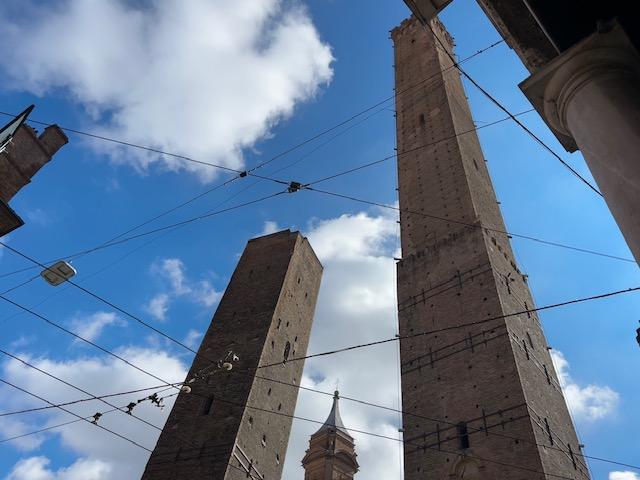
The Two Towers, the undisputed symbol of the city and reachable on foot in just a few minutes from our hotel in Piazza Maggiore in Bologna, stand at the crossing of the ancient roads that once led to the five gates of the torresotti wall circle.
The names Garisenda and Asinelli come from the families traditionally credited with their construction, although their true origin remains uncertain due to the scarcity of documents from the period. It is believed that the Asinelli Tower was originally taller: the summit we see today is the result of rebuilding work carried out under the Bentivoglio family (1488), which reduced it to its current height of 97.2 meters. In the 14th century it passed to the City, which used it as a prison and stronghold; during the Second World War, it served as a lookout point, with four volunteers stationed at the top during air raids to direct rescue efforts toward the areas struck.
The Garisenda, on the other hand, originally stood 60 meters tall, but was shortened in 1352 after its foundations began to sink during construction. In 2023, major consolidation works began, aimed above all at securing the Garisenda.
Legends of the Towers
Numerous popular legends tell that the two towers were built in a single night by the devil — a tale perhaps born to explain the Garisenda’s lean. That tilt soon became a distinctive feature of the medieval urban landscape, so much so that even Dante Alighieri mentions it in Canto XXXI of the Inferno in the Divine Comedy, using it as a visual simile to describe the giant Antaeus:
"As Carisenda seems, to one who stands
beneath the leaning side, when clouds pass by
above it, moving contrary, so it seems
to lean, so did Antaeus seem to me,
to one who watched, expecting him to bend,
and at that point I wished I'd gone another way."
Art Hotel Commercianti: Your Base in the Heart of the Tower City
Staying at a boutique hotel in Bologna like Art Hotel Commercianti means living every day in touch with this thousand-year-old history. Housed in an ancient palazzo in the historic center, the hotel stands just steps from the Two Towers and Piazza Maggiore, in a location that turns every walk into a small journey through medieval Bologna.
Our rooms at Art Hotel Commercianti blend the charm of historic surroundings with modern comfort, ideal for those seeking a historic stay in Bologna without giving up anything. For those visiting the city for business as well, we also offer meeting rooms in the heart of Bologna, perfect for meetings and events in a setting entirely unique of its kind.
Whether you're a history enthusiast, curious about medieval legends, or simply looking for a charming hotel in the center of Bolona from which to explore the city on foot, Art Hotel Commercianti is the ideal starting point for discovering the towers and all the other treasures of Bologna.